Giusy Lauriola
Vanishing at the Correale Museum in Sorrento
In the silence of the Correale Museum's halls, the works from the Vanishing project were exhibited, for the first time, alongside the Correale brothers' art collections, a universe spanning the 17th to 19th centuries that speaks calmly of history, memory, and time.
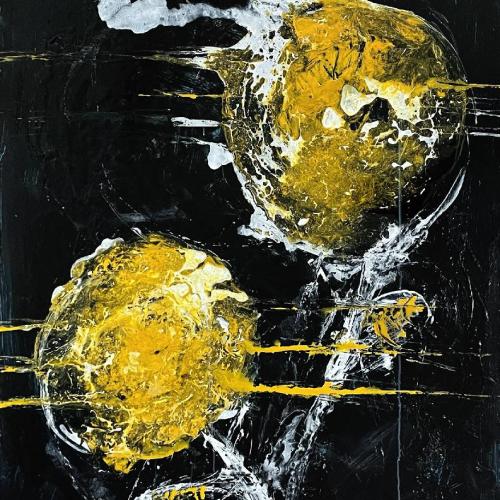
The resin, acrylic, and enamel canvases, the breathing flowers/nuclei, the figures oscillating between disappearance and rebirth, offered themselves up for dialogue with the ancient masterpieces: a transparency that is not escape, but presence.
During the exhibition week (October 12-18, 2025), school students, families, and tourists were invited to ask themselves three simple yet powerful questions:
"What do you see?", "What do you feel?", "Which work would you take home and why?"
And the answers were engraved like fingerprints: the voices of the youngest visitors expressed surprise and wonder: "I never thought a flower could seem alive," "The woman looks at me and speaks to me without words."
A subtle thrill can be sensed in those comments: the awareness that art is not just contemplation but participation, that every canvas is an invitation to remain, not to fade away.
The work "My Magdalene," inspired by Artemisia Gentileschi's Penitent Magdalene, has become a catalyst for emotion: the young people describe it as "a woman who rises," "a silent scream that finds light," "a gentle, wounded strength." This is emotional participation: no longer just looking, but feeling, a pulse that spans generations, connecting those who hold a smartphone and those who paint with color-soaked fingers.
This encounter between ancient and contemporary art, between matter and transparency, has created a bridge between past and present. Fading here is not synonymous with disappearing: it is becoming something else, transforming, remaining in the memory and breath of the observer.
In the young people's faces, we saw the silence that precedes thought. They expressed "I bring home an emotion" rather than "I bring home a painting." And perhaps it is precisely there that the deepest meaning is measured: in the emotion that endures, beyond time, beyond age.
Thus this stage becomes a watershed: not just an exhibition, but a circle of light that illuminates what is within. The works are not silent readers of history, but windows opening onto the present. And the young people who participated, with their genuine, spontaneous comments, became active participants, "reading" the work with new eyes, bringing their voices into the museum.
*"I saw the light in a flower."
*"I heard the silence of a strong woman."
Their words remain. And I welcome them, because it is in that welcome that Vanishing finds its truest form.
Acknowledgements
Sincere thanks to the Association Le Amiche del Museo Correale and the SyArt Gallery for their invaluable support. To the Board of Directors of the Museo Correale, who accepted the Association's proposal.
Special thanks to the students and teachers of local schools, who, with their sensitivity and spontaneity, have given voice and life to this dialogue between past and present.
Thanks also to all the visitors who have left a thought, an emotion, a fragment of themselves: it is thanks to them that Svanire continues to transform into a place of listening and sharing.
GIUSY LAURIOLA
artist
Ph credit Giovanni De Luca
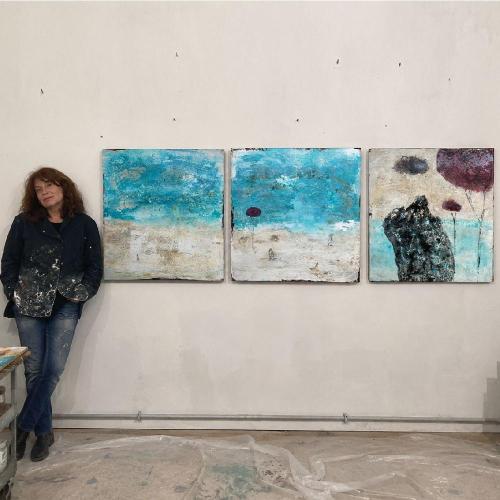
(The artist with the owner gallery and curator Rossella Savarese)

Artworks





Artist info

Biography
Giusy Lauriola is an Italian artist born and residing in Rome, where she has her studio. Lauriola's technique manifests itself in an astonishingly eloquent and engaging manner. Colors play a central role, not merely as pigments but as carriers of deep, hidden emotions. Her brushstrokes seem to channel a primordial instinct, as if each touch were an unconscious call to the energy of nature.
The texture she creates is captivating: resin adds a material dimension that transforms the flat canvas surface into a tactile, almost sculptural place. The contrast between fluidity and structure is evident in the way resin integrates with acrylic and enamel, creating a dialogue between the liquid and solid, the instinctual and the intentional. This combination of materials emphasizes an artistic process that appears as deliberate as it is instinctive.
There is a visible tension between the figurative and the abstract, inviting the viewer to explore each work as an inner landscape. Each of her creations feels like a powerful reflection on the dualism between the visible and invisible, on what emerges and what remains hidden, compelling the observer to question and immerse themselves in a suspended, intimate, and vibrant dimension. The use of space, often empty or undefined, imparts a metaphysical quality to her works, evoking a realm beyond time and space, like a window opened onto the unconscious.
Lauriola's remarkable ability to modulate light and color becomes almost a meditative act, inviting the viewer to “close their eyes” and perceive the work through sensitivity rather than sight. This gestural and free approach distinguishes her, imbuing her work with a depth that connects her inner world with the outer one. Over time, the artist has also succeeded in maintaining a guiding thread across the different series she has created, preserving a thematic coherence and an ability to explore universal emotions. These are expressed with an original approach to materials and through the harmony she creates between abstraction and figuration—central elements of her poetics of color and form.
In 2004, her first exhibition took place. Recent exhibitions include: 2025- Svanire Correale Museum in Sorrento (curated by Rossella Savarese); 2024 - International Rome Art Fair, La Nuvola Roma Eur 2024 : Linea Sottile – Palazzo Marziale, Sorrento (curated by Rossella Savarese); Suspended in Nature – Spazio Cima Gallery, Rome; 2023: The Sky in a Room – Auditorium di San Pancrazio, Tarquinia (curated by Hans Achtner); Close Your Eyes – Aranciera di San Sisto, Rome, and Artetika Gallery, Palermo (curated by Federica di Stefano and critical text by Carlo Ercoli); 2022: Let's Take the Marshy Path to Get to the Clouds – Galleria Umberto Mastroianni at the San Salvatore in Lauro Museums, Rome (curated by Federica di Stefano and critical texts by Manuela De Leonardis and Carlo Ercoli); 2021: International SyArt Festival Sorrento, Villa Fiorentino – Fondazione Sorrento; Illustrated boards for the editorial project Guido Levi, a story full of Fears, anxieties and almost yellow events, edited by Manuela De Leonardis; Amabie, The Magical Prophecy of the Yōkai – Mo.CA Studio Gallery, Rome (curated by Manuela De Leonardis); 2020: Infinite Perimeter – Spazio Cima Gallery, Rome; 2019: Domino/Dominion for fun and for real – MACRO, Museum of Contemporary Art, Rome; About Dreams, Mo.CA – Studio Gallery, Rome; Stateless/identities not dispersed – Palazzo Merulana, Rome.
AWARDS AND RECOGNITIONS: Finalist of the Singulart International Women's Day 2025 Award, in 2021, at the SyArt Sorrento International Festival, she received the prestigious Arbiter Fata Verde Award, and in 2022, she was featured on the cover of Arbiter magazine. She also received an Honorable Mention from the Circle Foundation for the Arts in 2020 and 2022 and was a finalist in major awards such as the Premio Lupa 2020 and the Celeste Prize 2007. In 2015, she won the Museo Pier Maria Rossi competition.
Her works are held in prestigious collections, including the Copelouzos Family Art Museum in Athens, the SanPaolo Invest Art Collection in Rome, and the Antonio Sapone Municipal Art Gallery in Gaeta. From 2021 to 2024, she participated in numerous contemporary art fairs, including Arte in Nuvola in Rome and fairs in Genoa, Padua, and Parma. In 2020, she was included in the Atlas of Contemporary Art by De Agostini, one of the most comprehensive surveys of Italian artists since 1950. Her career has led her to exhibit internationally, as an honored guest at the International Photo Festival in Lodz, Poland, in 2006, and in solo exhibitions at prestigious venues such as the Italian Cultural Institute in Damascus in 2010 and the Italian Cultural Institute in Tokyo in 2024, for Holocaust Remembrance Day.
Critical texts for her catalogs have been written by Giorgia Calò, Maurizio Calvesi, Antonietta Campilongo, Cristina Del Ferraro, Manuela De Leonardis, Federica Di Stefano, Micol Di Veroli, Barbara Drudi, Carlo Ercoli, Gianluca Marziani, Manuela Pacelli, Rossella Savarese , Sergio Rispoli, and Agnieszka Zakrzewicz.